THE GRAND SPORT: WHAT MIGHT HAVE BEEN
THE GRAND SPORT: WHAT MIGHT HAVE BEEN—AND WHAT STILL CAN BE
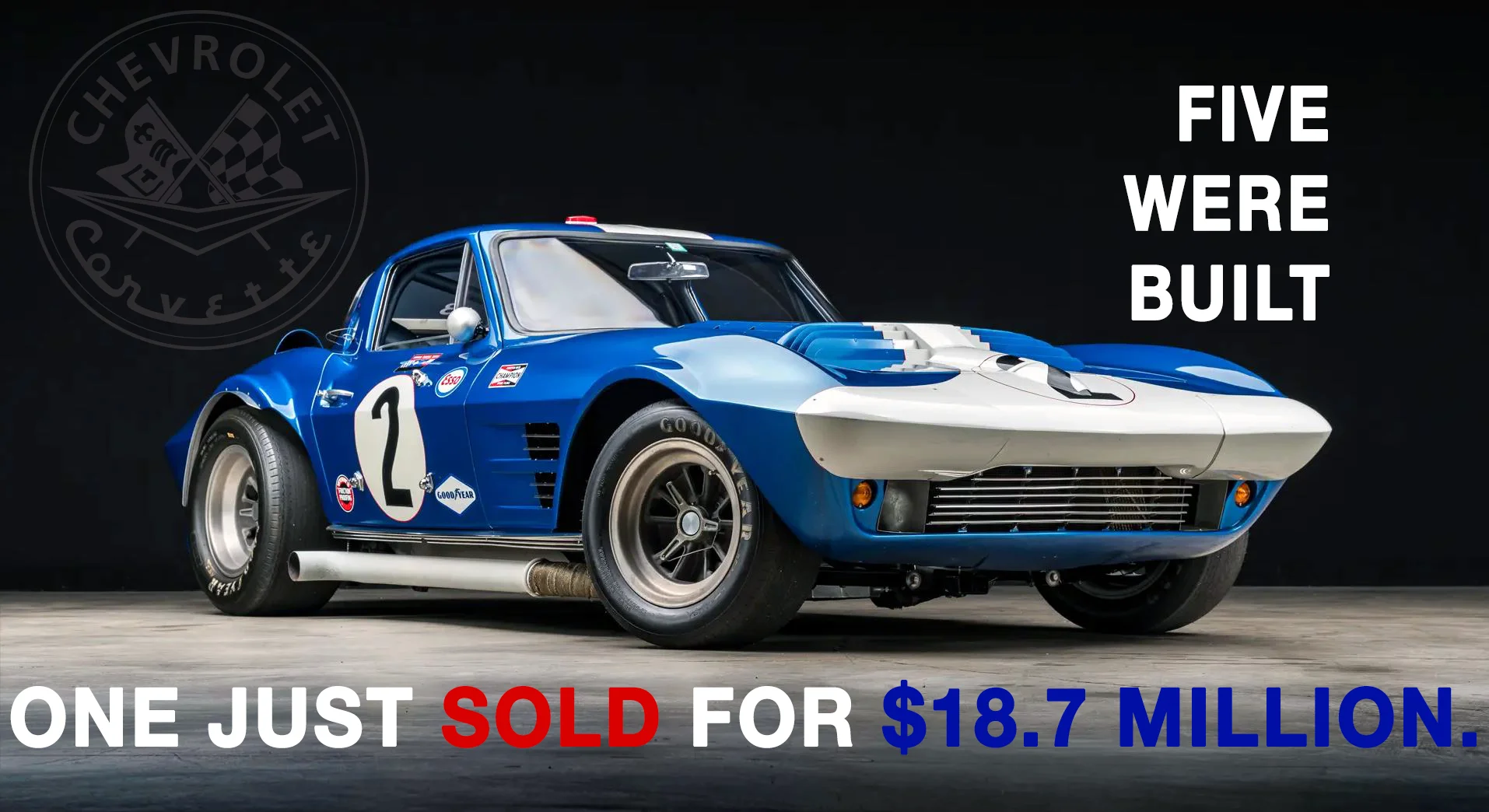
At this year’s RM Sotheby’s Monterey auction, one of the most important competition Corvettes ever created crossed the block for an extraordinary $18,705,000.
It was not simply a rare 1963 Corvette. It was Grand Sport chassis 003—one of only five original Grand Sports ever constructed and the first of just three coupes.
Its sale was a powerful reminder of what makes the Grand Sport so important. This was the Corvette that was never supposed to exist—and the race car Chevrolet was never allowed to fully develop.
In 1962, legendary Chevrolet engineer Zora Arkus-Duntov began work on an uncompromising lightweight Corvette designed to challenge the world’s best competition cars. His original plan called for 125 examples, enough to establish the Grand Sport as a production-based GT contender.
Instead, General Motors’ prohibition against factory racing brought the program to an abrupt end after only five cars had been completed.
But those five survived—and they proved exactly what Duntov believed they could.
Chassis 003 earned three SCCA class victories during the 1963 season before joining the Mecom Racing Team at Bahamas Speed Week. It later finished second in class at the 1964 12 Hours of Sebring and third in class at Sebring in 1965. Along the way, it was driven by some of America’s greatest racing talents, including A.J. Foyt, Jim Hall, Augie Pabst, John Cannon, Dick Thompson, and Delmo Johnson.
At Nassau, the Grand Sports did precisely what they had been created to do: they defeated the Shelby Cobras and earned a lasting nickname—“Snake Eaters.”
Only five originals exist. They are now among the rarest, most historically significant, and most valuable American competition cars ever built.
But unlike most legendary automobiles seen crossing an auction block, the Grand Sport story does not have to end behind museum ropes.
The Superformance Corvette Grand Sport is an officially licensed continuation of Duntov’s extraordinary machine. Built using licensed tooling, it faithfully recreates the unmistakable wide-body design, lightweight construction, original-style tubular chassis, competition-inspired cockpit, and raw racing character of the 1963 Grand Sport.
Each car is supplied as a professionally assembled rolling chassis, allowing its owner to choose a powertrain that reflects the Grand Sport’s past—or create the car Duntov might have developed had the original program been allowed to continue.
An original Grand Sport now commands nearly $19 million, and another opportunity to purchase one may not appear for decades.
For those who want more than the privilege of looking at history, the Superformance Grand Sport offers something exceptionally rare: the opportunity to experience it.
Not merely a tribute to what was.
The closest most of us will ever come to owning what might have been.